Got a BRAND NEW How to Sculpt video coming at you, this one focusing on getting started with armatures.
It's also the first wholy new video I've shot in nearly 4 years! I got a bit disheartened with how much work goes into these things, and how little folks seemed to care about them.
But I've been getting a steady stream of subscribers to my YouTube Channel of late, and that, combined with a swift kick in the ass from my brother Hydra, inspired me to get this video shot, edited, and uploaded inside of 24 hours! No dragging my feet on synching audio and editing down. Just a one-shot, direct to digital product.
So it's a little rough around the edges in places, but I hope you like it and find it helpful!
Note: I'm also posting this from my phone, so I'm sorry if it Le Bust.
This How to Sculpt Miniatures series is my attempt to demystify the idea of sculpting your own miniatures. It seems that more and more people are taking cracks at it these days as the means of production are getting so very cheap and third-party casting companies are growing like mushrooms. Still, no matter how many head-swap bits are retailed, there is going to come a time when you have an awesome idea for a miniature, and there might not be a compatible, ready-made bit. You're going to have to make it yourself, and it is my belief that the only thing standing in your way is a few helpful tips.
Greetings Epoxy Crafters!
I was trying to decide whether to write this article or not to write this article. I figured that if anyone was interested in procuring the tools/materials I highlighted, they would probably just look them up on the Internet, but, in case you're lazy or you're looking for some direction, I'll go over where I found the tools and materials I recommend.
This How to Sculpt Miniatures series is my attempt to demystify the idea of sculpting your own miniatures. It seems that more and more people are taking cracks at it these days as the means of production are getting so very cheap and third-party casting companies are growing like mushrooms. Still, no matter how many head-swap bits are retailed, there is going to come a time when you have an awesome idea for a miniature, and there might not be a compatible, ready-made bit. You're going to have to make it yourself, and it is my belief that the only thing standing in your way is a few helpful tips.
Like I mentioned in my previous article on tools: I don't consider myself a trained professional, just an experienced amateur. Thus, I'm going to be talking about the putties I use, but, unfortunately, I won't be able to tell you anything about super sculpey or milliput, procreate or brown stuff. But that's alright because it's my goal to convince you that all you really need for 98% of your sculpting projects are two reasonably cheap, readily available putties. This article will be a general overview with a few tips about how to have more control over your putty, but it got a little long, so I will be saving hands-on techniques for my next installment. Still, I hope you find this one helpful in getting you better acquainted with sculpting mediums.
UPDATE: I've just polished off the video versions of these tutorials, and you'll find the second video, all about putty, below. The video is best consumed as an illustration to this article, so I'd still recommend reviewing both. ENJOY!
This How to Sculpt Miniatures series is my attempt to demystify the idea of sculpting your own miniatures. It seems that more and more people are taking cracks at it these days as the means of production are getting so very cheap. Whether you take it on the old fashioned way, with rubber and resin and lots of painstaking sculpting, or via the Quick N Dirty route of 3D CAD/Printing, the Internet has offered the instructions and made cheap the tools required to make your own models. This has lead to third-party miniature companies growing like mushrooms, increasing the diversity of 28mm scale models out there to a degree that was never previously imagined.
Still, no matter how many head-swap bits are retailed, there is going to come a time when you have an awesome idea for a miniature, and there might not be a compatible, ready-made bit. You're going to have to make it yourself. I speak from experience when I say this is a daunting prospect. I am not a Sculptor. I was not professionally trained, and I dropped out of Art after the tenth grade on the belief that I wasn't talented enough to continue. Anything I know about sculpting, I learned by doing, and I learned it trying to make better models. All I can tell you is what I have learned, but it is my hope that through some simple articles, I might be able to impart all the basic knowledge you need to get started at sculpting. After that, it's all up to how much you practice :)
I wasn't sure whether to start this series with Tools or Materials, but I've elected to go with Tools. In this article, I'm going to give examples of the kinds of tools I use along with photos of each one.
UPDATE: I've just polished off the video versions of these tutorials, and you'll find the first video, all about tools, below. The video is best consumed as an illustration to this article, so I'd still recommend reviewing both. ENJOY!
Sculpting miniatures becomes much easier once you have some proper tools to work with, but that isn't to say that you should head out to your local art shop and buy up every sculpting tool they have on hand. I have been rather disappointed to find that the majority of the tools in my local art shops are for sculpting clay, and they are nowhere near fine enough for the kind of work you want to do when sculpting miniatures.
To build up some content on the site, I'm going to be posting a few of my past projects that were kind of like milestones in my development as a sculptor. I'll call them "Old Strains," and you can feel free to check them out if you're curious.
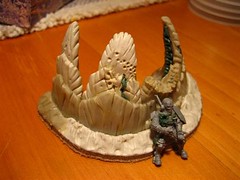
Well, repurposing walnuts, coral, and lotus seed pods is all well and good for some quick-and-dirty Tyranid terrain, but I've never been much of one for quick-and-dirty as far as modelling is concerned. So I listened to that little voice that every 40K player has inside his/her head: the one that looks at the foam packaging that your new monitor came in and thinks "that would make a pretty bad-ass piece of scenery." Except, I followed this voice a little further down the rabbit hole than most do, seeing a fantastic-piece-of-Tyranid-scenery-to-be in this: